

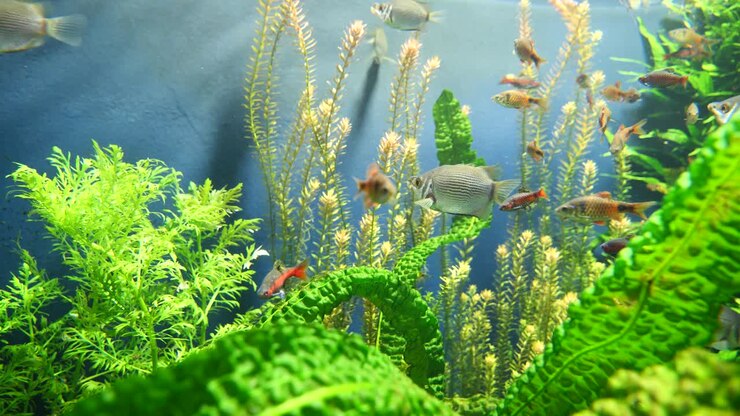
Few experiences in fishkeeping are quite as jarring as waking up, turning on the aquarium light, and finding that your once crystal-clear aquatic display looks like a glass of diluted skim milk. Your immediate impulse might be to suspect a failing filter, blame a bag of unwashed gravel, or panic about mysterious chemical contaminants leaching into the water.
In the vast majority of cases, the culprit is far closer to home. It sits right on the shelf above the tank in a colorful plastic container.
The heavy hand with the food container is responsible for more aquatic emergencies, mysterious illnesses, and murky tanks than almost every equipment failure combined. Feeding your fish is the most interactive, emotionally satisfying part of owning an aquarium. It feels like an exchange of affection: you approach the glass, your fish dart frantically to the surface with expectant wiggles, and you reward them with a generous pinch of flakes or pellets.
Unfortunately, that daily gesture of kindness often sets off a catastrophic microscopic chain reaction. Understanding why overfeeding causes cloudy water—and how that cloudiness threatens the lives of your livestock—is the first step toward achieving the pristine, biologically balanced aquarium you set out to build.
The Anatomy of a Bacterial Bloom: What Cloudy Water Actually Is
When tank water suddenly turns milky or hazy white, you are almost never looking at pulverized fish food floating suspended in the current. You are looking at a living, rapidly multiplying population explosion known as a heterotrophic bacterial bloom.
Aquariums house two distinct classes of beneficial bacteria: autotrophs and heterotrophs. Autotrophic bacteria are the slow-growing nitrifiers that form your biological filter, converting toxic ammonia into nitrite and then into nitrate. They reproduce very slowly, often requiring twenty-four to thirty-six hours to double their population size.
Heterotrophic bacteria, on the other hand, are the cleanup crew of the microscopic world. Their sole mission is to consume non-living organic matter—decaying plant leaves, fish feces, and uneaten commercial fish food. Unlike the nitrifiers, heterotrophs are biological sprinters capable of doubling their population every fifteen to twenty minutes under the right conditions.
When uneaten food drifts down between gravel crevices, settles behind driftwood, or gets sucked into filter sponges, it creates a massive surplus of dissolved carbohydrates, proteins, and lipids. In response to this sudden feast, the background population of heterotrophic bacteria explodes exponentially.
Within twelve to twenty-four hours, billions of these microscopic organisms multiply in the open water column. The water turns hazy, then milky, and finally opaque white as their sheer collective mass diffuses the light passing through the glass. The cloudiness is not dirt; it is a raging biological wildfire feeding on uneaten nutrition.
The Hidden Chemical Cascade Beneath the Fog
A milky tank is an aesthetic eyesore, but the biological hazards lurking beneath the haze are far more sinister. A bacterial bloom is rarely just a visual annoyance; it is a full-blown physiological crisis for every gill-breathing animal in the tank.
The Threat of Critical Oxygen Depletion
Heterotrophic bacteria are strictly aerobic organisms. As billions of them reproduce and metabolize rotting food, their biological oxygen demand spikes dramatically.
In a confined aquatic ecosystem, these bacteria actively compete with your fish for every milligram of dissolved oxygen. A severe bacterial bloom can strip the oxygen out of a twenty-gallon tank within hours, particularly at tropical temperatures where warm water already holds less dissolved gas.
If you notice your fish congregating near the surface, gasping at the interface where atmospheric air meets the water, or resting lethargically at the bottom with flared, rapidly pumping gills, they are suffocating. The cloud of bacteria is literally breathing away their life support.
The Ammonia and Nitrite Surge
Fish food is exceptionally dense in protein. As heterotrophs break down those proteins, the primary chemical byproduct they release directly into the water column is unionized ammonia.
Under normal conditions, your established biological filter handles minor ammonia inputs effortlessly. However, a massive surge of rotting food produces an ammonia wave that completely overwhelms the slow-reproducing autotrophic bacteria colonizing your filter media. The nitrifying bacteria simply cannot multiply fast enough to process the sudden load.
As ammonia levels spike, the chemical burns your fish’s delicate gill membranes, strips away their external slime coat, and enters their bloodstream, causing neurological damage and systemic organ failure. Even if your filter manages to process the initial ammonia, you will likely face a secondary nitrite spike, which binds to the hemoglobin in your fish’s blood and prevents oxygen transport from the inside out.
pH Instability and Organic Acid Build-Up
Decomposing organic matter releases organic acids that actively consume the mineral buffers—specifically carbonate hardness—present in your tap or conditioned water. If your water has modest buffering capacity, an overfeeding event can exhaust those buffers entirely, precipitating a dangerous pH crash.
A sudden drop of a full point or more on the pH scale triggers osmotic shock in fish, compromising their cellular balance and leaving them acutely vulnerable to opportunistic fungal and bacterial pathogens.
Why Fish Always Look Starved (And How They Trick You)
To stop overfeeding, you have to overcome the psychological manipulation of your fish.
Virtually every common aquarium species—from neon tetras and guppies to cichlids and goldfish—is an opportunistic feeder shaped by millions of years of evolutionary pressure. In their natural habitats, food is scarce, unpredictable, and fiercely contested. Wild fish never know when their next mosquito larva, algae patch, or fallen insect will appear.
Consequently, their brains are hardwired with a simple survival rule: if food presents itself, eat it immediately, regardless of physical fullness.
Fish lack the neurological mechanisms that signal human satiety. They do not experience the sensation of feeling stuffed after a holiday meal and deciding to push away from the table. When your fish rush to the front glass, swim in frenzied circles, and beg at the surface every time you walk past, they are not communicating that they are starving. They are displaying a hardwired biological instinct paired with a learned association between your silhouette and the presence of food.
Furthermore, a fish’s actual stomach capacity is remarkably small. In most species, the stomach is roughly the size of the animal’s eye. A single flake or two small pellets are often more than enough to completely pack their digestive tract. Anything consumed beyond that capacity passes through poorly digested, producing voluminous waste that fuels water cloudiness, while whatever sinks past their mouths rots on the tank floor.
Emergency First Aid: Rescuing a Tank from Feeding Fallout
If your aquarium has already transformed into a milky soup and your fish are visibly stressed, you must take deliberate, calculated steps to stabilize the system. Panicked, extreme measures will often kill more fish than the cloudiness itself.
Step 1: Maximize Surface Agitation and Aeration
Your immediate, minute-one priority is keeping your fish breathing while you address the root cause.
-
Drop an auxiliary air stone connected to a strong air pump directly into the middle of the tank.
-
Reposition your filter outflow nozzle or lower the tank’s water level by an inch or two to allow the returning water to splash vigorously across the surface.
-
Surface turbulence breaks the oily protein film that forms during blooms and maximizes the gas exchange rate, forcing life-saving oxygen into the depleted water column.
Step 2: Manually Extract the Physical Fuel
You cannot fix a bacterial bloom while the buffet is still sitting on the table. Every pellet of rotting food left in the tank will continue feeding billions of new bacteria.
Take a gravel vacuum and thoroughly siphon the substrate, focusing on low-flow corners, behind rocks, and around plant bases where uneaten food naturally settles. If a massive amount of food was dumped accidentally (a common occurrence when curious children or well-meaning house sitters get involved), siphon out the worst of the accumulation immediately, even if it means pulling twenty to thirty percent of the water with it.
Rinse your mechanical filter media—sponges, filter floss, and pre-filter covers—in a bucket of siphon-drained tank water to clear out decaying sludge. Never wash biological filter media in chlorinated tap water, as doing so will kill off what remains of your beneficial nitrifying colonies.
Step 3: Implement Controlled, Temperature-Matched Water Changes
Do not make the fatal mistake of draining ninety or one hundred percent of the water in an attempt to start over. Completely stripping the tank shocks your fish, destroys the delicate equilibrium of your biofilm, and often triggers a second, even more violent bacterial bloom forty-eight hours later.
Instead, execute a disciplined twenty-five to thirty percent water change.
Ensure the new water is thoroughly dechlorinated and matched within one or two degrees of the aquarium’s current temperature. This volume change safely dilutes dissolved organics, lowers ambient ammonia concentrations, and removes billions of free-floating bacteria without shocking your livestock’s osmotic balance. Repeat this modest water change every twenty-four to forty-eight hours until the water clears.
Step 4: Enforce an Uncompromising Fast
Once you have cleaned the gravel and adjusted the water, step away from the food container.
Enact a strict feeding ban for the next forty-eight to seventy-two hours.
Healthy tropical fish can comfortably survive a week or more without food with zero adverse health consequences. In fact, short fasting periods are beneficial, giving their digestive tracts time to clear out accumulated waste. Denying your fish food for two or three days cuts off the organic fuel feeding the heterotrophic bloom. As the food source runs dry, the bacterial population will starve, collapse, and be consumed by microscopic protozoa, leaving the water clear once again.
Recalibrating Your Feeding Habits for Permanent Clarity
Recovering from an overfeeding emergency is exhausting; preventing the next one is remarkably simple once you establish a reliable feeding discipline.
The Sixty-Second Observation Rule
Ditch the old advice of offering “what your fish can eat in five minutes.” In five minutes, an eager school of tetras or barbs can consume enough processed food to foul a small aquarium for a week.
Switch to the sixty-second observation method:
-
Offer a tiny pinch of food—barely three or four flakes or a small sprinkle of micro-pellets.
-
Stand directly in front of the tank and watch the food fall.
-
Every single morsel should be consumed before it touches the substrate.
-
If food hits the sand or gravel and sits untouched for more than sixty seconds, you have provided too much.
Feed your fish once a day, or even six days a week, reserving one day as a scheduled fasting day to allow their digestive systems and your biological filtration to completely catch up.
Upgrading the Quality of Your Food
Not all fish foods behave the same way in the water column. Inexpensive, low-grade flake foods are packed with indigestible grain fillers, soy meal, and artificial binders. When these flakes hit the water, they begin dissolving almost instantly, leaching clouds of micro-nutrients and starches into the water before the fish can even swallow them.
Invest in high-density, slow-sinking micro-pellets or premium crisps formulated with whole marine proteins like whole krill, black soldier fly larvae, or squid meal. High-quality foods maintain their structural integrity in the water, resist immediate dissolution, and provide far higher nutrient absorption, resulting in smaller, firmer fish waste and a dramatically lower organic load.
Handling Vacations and Automated Feeders
A disproportionate number of tank wipeouts occur when owners go out of town. Anxiety about leaving pets unattended often leads owners to drop chalky vacation feeding blocks into the tank, or worse, entrust the feeding duties to a neighbor who has never kept fish.
Vacation feeding blocks are notorious for disintegrating into powdery, chalky sludge that feeds massive bacterial blooms within seventy-two hours of departure. Similarly, an untrained neighbor will almost invariably overfeed because they interpret the fishes’ begging behavior as starvation.
If you are traveling for a week or less, the safest option is to feed nothing at all. Your fish will graze naturally on microscopic biofilm and algae, remaining completely safe and healthy until you return. If you are away for longer, purchase a high-quality electronic auto-feeder and test its portion output over paper towels for several days before mounting it on the aquarium, or portion out individual daily rations into a weekly pill organizer, hiding the master food container completely from your house sitter.
Letting Biology Do the Heavy Lifting
When confronted with milky water, many hobbyists rush to their local fish store to buy chemical clarifiers, flocculants, or algaecides. Chemical clearing agents bind tiny particles into clumps large enough for mechanical filters to trap. While this works well for fine mineral dust or sand silt, it is entirely ineffective against a living, reproducing heterotrophic bacterial bloom. Dumping clarifiers into a biological bloom only adds unnecessary chemical stress to an already compromised aquatic environment.
The path to immaculate, polished water does not run through chemical additives or panicked tank tear-downs. It is carved by biological patience.
By recognizing that cloudy water is simply nature’s way of recycling an artificial glut of nutrients, you can take control of the environment. Cut off the fuel supply, remove the physical debris, boost your dissolved oxygen, and let your biological filtration do the job it was designed to do. When you master the discipline of the food container, you eliminate the single greatest threat to your aquarium’s clarity, ensuring your fish live in water that is not only clean to look at, but safe and healthy to swim in.
