

Walk into almost any big-box pet retailer, and you will encounter a shelf lined with rows of tiny, stackable plastic cups. Inside each container sits a solitary Siamese fighting fish (Betta splendens), fins clamped, floating almost motionless in a few ounces of dyed blue water. A few aisles away, merchandise displays promote colorful half-gallon plastic cubes, desktop decorative globes, and novelty vases topped with peace lilies, marketed specifically as ideal homes for these vibrant aquatic creatures.
This merchandising strategy has sustained one of the most widespread and damaging myths in modern pet keeping: the belief that bettas are low-maintenance, decorative novelties that prefer cramped, stagnant water.
Generations of well-meaning pet owners have brought bettas home under the impression that an unheated glass bowl on a kitchen counter is an adequate environment. When the fish becomes listless, dull in color, and succumbs to disease after six or eight months, owners often assume the animal simply reached the natural end of its life. In truth, a healthy betta in an appropriate environment regularly lives between three and five years, sometimes longer. The quiet tragedy of the domestic betta is that its extraordinary biological resilience has been mistaken for comfort, allowing an industry of neglect to thrive under the guise of convenience.
Deconstructing the Rice Paddy Myth
The cornerstone of the betta bowl industry is a misinterpretation of the species’ native wild habitat. Proponents of bowl keeping often claim that bettas naturally inhabit muddy buffalo footprints, shallow drainage ditches, and stagnant puddles across Southeast Asia. The argument suggests that providing a betta with a spacious, filtered aquarium is unnatural, and that small, still water replicates their wild home.
This narrative distorts basic ecology. While wild bettas throughout Thailand, Cambodia, and the Mekong River basin do inhabit shallow waters—such as flooded agricultural paddies, marshes, and slow-moving streams—these water bodies are anything but small. A rice paddy may only be several inches to a couple of feet deep, but it stretches across thousands of continuous acres.
This vast expanse represents a massive volume of water. It features intricate root systems, dense aquatic vegetation, and a constant, natural biological cycling process driven by sunlight, substrate microbes, and gentle water turnover. The water is rich in microfauna, heavily shaded by plant canopies, and chemically buffered by decaying botanical matter. Wild bettas roam established territories covering several square feet, navigating complex underwater topographies in search of insect larvae and small crustaceans.
The only time a wild betta finds itself confined to a shrinking puddle is during severe seasonal droughts. In those desperate circumstances, the puddle is not a preferred paradise; it is a temporary ecological trap. Many fish die when these temporary pools evaporate completely or become saturated with waste. Pointing to a drying drought puddle to justify keeping a captive fish in a two-quart bowl is the equivalent of keeping a camel locked in an unventilated closet because camels can survive harsh desert droughts.
The Evolutionary Purpose of the Labyrinth Organ
Central to the myth of the bowl-dwelling betta is the fish’s unique anatomy. Bettas belong to the suborder Anabantoidei, a group of freshwater ray-finned fishes distinguished by a specialized auxiliary respiratory structure known as the labyrinth organ.
Located in an expanded cavity above the gills, the labyrinth organ consists of vascularized, folded plates of bone and tissue that function much like a primitive lung. By taking gulps of atmospheric air at the water’s surface, a betta can extract oxygen directly into its bloodstream.
This remarkable evolutionary adaptation developed as a life-saving survival tool. In the warm, tropical waters of Southeast Asia, elevated water temperatures and decaying vegetative matter frequently deplete dissolved oxygen levels in the water column. The labyrinth organ allowed ancestral bettas to thrive in oxygen-poor margins where competitors would suffocate, and to survive temporary dry-season strandings until the monsoon rains replenished their habitats.
Marketers have seized upon this anatomical feature to argue that bettas do not need water flow, aeration, or filtration. They claim that because the fish can breathe air from above, the quality of the water underneath is irrelevant.
This reasoning completely ignores the fact that bettas still possess functional gills, complex kidneys, and sensitive skin that interface directly with the aquatic environment. A betta forced to rely exclusively on its labyrinth organ because the water is foul, depleted of dissolved oxygen, and chemically toxic is an animal in acute respiratory distress. The labyrinth organ is an emergency biological backup system, not a license to withhold clean water.
The Thermal Imperative: Why Room Temperature Is Too Cold
Fish are ectothermic organisms. Unlike mammals and birds, which burn metabolic calories to maintain a consistent core body temperature regardless of ambient weather, a fish’s internal temperature mirrors the water surrounding it. Every physiological process inside a betta’s body—from heart rate and enzyme production to cellular repair and digestive motility—is dictated entirely by ambient water warmth.
The Breakdown of Cold Metabolism
The tropical river basins where bettas evolved maintain steady temperatures between 78°F and 82°F (25.5°C to 28°C) year-round.
When a betta is placed in an unheated bowl inside an air-conditioned American home, the water temperature typically settles between 68°F and 72°F. While this may feel comfortable to a human walking through the living room, to a tropical labyrinth fish, it represents a state of chronic, numbing hypothermia.
At these depressed temperatures, the biochemical reactions required for life slow to a crawl. The digestive tract becomes paralyzed. Enzymes cannot break down proteins, causing food to ferment inside the stomach and intestines. This leads directly to chronic constipation, severe abdominal bloating, and swim bladder disorder, a painful condition that leaves the fish unable to control its buoyancy, leaving it stranded floating at the surface or pinned to the bottom.
Furthermore, cold water catastrophically suppresses the fish’s immune system. White blood cells lose their mobility and ability to neutralize pathogens. Microorganisms that are harmless to a warm, vigorous fish—such as fungal spores, velvet parasites, and opportunistic bacteria like Flavobacterium columnare—run rampant over a cold, compromised host. The common sight of an unheated betta resting motionless on the gravel with clamped, frayed fins is not an animal behaving calmly; it is an animal trapped in a state of lethargic torpor, slowly succumbing to chronic stress and opportunistic infection.
Choosing the Right Heating Equipment
Reliable thermal stability cannot be achieved through passive room warmth or proximity to a desk lamp. Desk lamps create dangerous temperature spikes during the day followed by rapid thermal crashes when turned off at night.
To thrive, a betta requires an adjustable, submersible aquarium heater equipped with an internal thermostat.
-
In smaller desktop environments, select a heater rated at roughly five watts per gallon of water volume.
-
Avoid cheap, preset heating pads that run continuously without automatic shutoff mechanisms, as these frequently overheat water or fail entirely during cold snaps.
-
Always pair any aquatic heater with an independent, easy-to-read digital or glass thermometer mounted on the opposite side of the tank to verify that the thermostat is operating accurately.
A steady 80°F baseline restores energetic swimming behavior, rich natural pigmentation, and healthy metabolic processing.
Biological Filtration and the Nitrogen Cycle
The most dangerous aspect of a small, unfiltered bowl is invisible. Water can look clear while being chemically lethal.
Every living fish generates waste. Bettas excrete solid waste from their digestive tracts and continuously release toxic ammonia directly into the water column across their gill membranes. Decaying bits of uneaten fish food, shed mucus, and fallen plant matter break down to produce additional ammonia.
The Chemistry of Ammonia Toxicity
Ammonia is a caustic cellular poison. In a small, unfiltered container holding one or two gallons of water, ammonia concentrations reach hazardous levels within twenty-four to forty-eight hours of feeding.
As ammonia accumulates, it causes severe microscopic chemical burns to the delicate gill filaments, stripping away protective mucus layers and causing the gill tissue to bleed, swell, and fuse together. The fish slowly suffocates even while surrounded by water. Externally, high ammonia levels cause painful chemical burns on the skin, causing the fins to blacken, curl, and erode away in a condition commonly known as fin rot.
The Essential Role of the Nitrogen Cycle
In a properly equipped aquarium, ammonia is managed not through constant chemical dosing or total water dumping, but through the cultivation of a living biological filter.
This biological process, known as the nitrogen cycle, relies on beneficial colonies of autotrophic bacteria that establish themselves on porous surfaces inside the aquarium:
-
First, species of bacteria (such as Nitrosomonas) consume toxic ammonia and convert it into nitrite.
-
Nitrite is equally hazardous, binding to hemoglobin in the fish’s blood and preventing oxygen transport.
-
A second class of beneficial bacteria (such as Nitrospira) oxidizes nitrite into nitrate.
-
Nitrate is significantly less toxic and can safely accumulate in modest concentrations between weekly maintenance intervals.
In a bowl without a filter, there is simply not enough submerged surface area or oxygenated water flow to support these bacterial colonies. Even if a small bacterial culture attempts to form on the gravel, the standard bowl-cleaning method—dumping out one hundred percent of the dirty water and scrubbing the bowl with tap water—wipes out the microscopic colony entirely, resetting the biological clock and exposing the fish to continuous chemical shock.
Sizing and Selecting Betta-Safe Filters
A common objection to filtering a betta tank is that filtration produces too much water turbulence. This concern is valid if an oversized power filter designed for active river fish is dropped into a small enclosure.
Domestic male bettas have been selectively bred for centuries to display heavy, flowing fins, including varieties such as halfmoons, rosetails, and feather-tails. These elaborate fins act like sails in the water, making sustained swimming against a stiff current exhausting and stressful. When buffeted by high-flow filters, long-finned bettas quickly become fatigued, tearing their delicate fin tissue on decorations or becoming pinned against the filter intake grate.
The solution is not to eliminate filtration, but to select the correct mechanical mechanism:
-
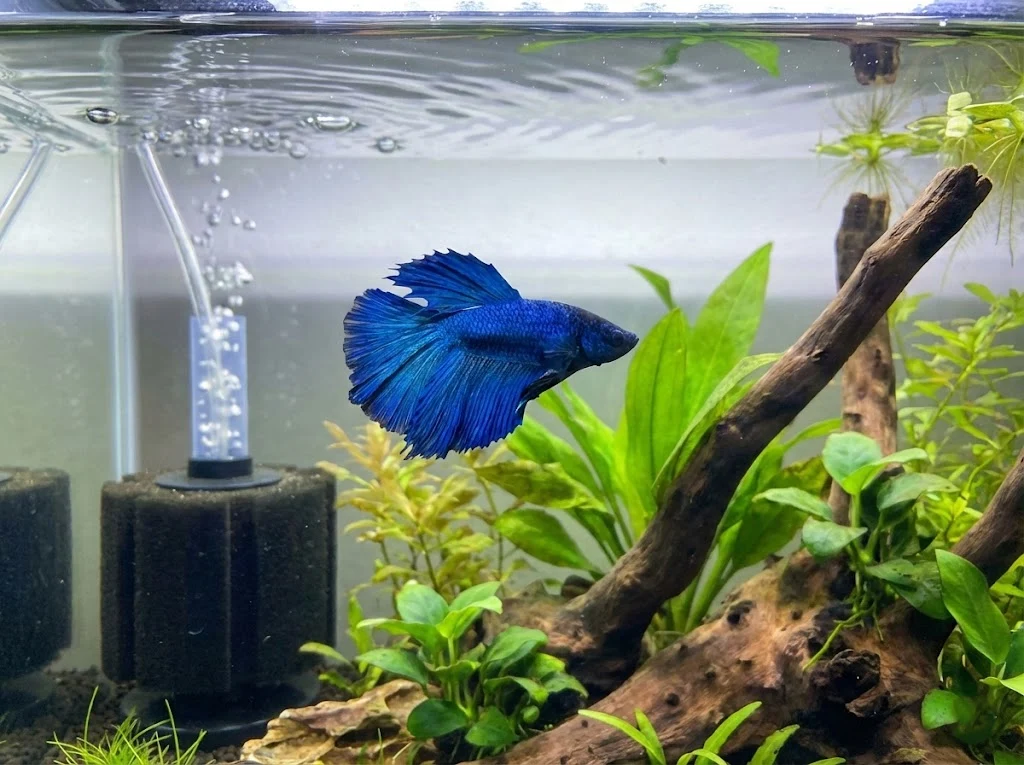
Sponge filters: An air-driven sponge filter is widely considered the ultimate filtration method for Betta splendens. Powered by a gentle aquarium air pump, a sponge filter pulls water through porous foam via air displacement. It creates zero dangerous suction, provides an enormous surface area for beneficial nitrifying bacteria to colonize, and introduces gentle surface agitation that oxygenates the water without creating turbulence.
-
Baffled internal filters: If an internal power filter or hang-on-back filter is used, choose a model featuring an adjustable flow control dial. Alternatively, mechanical baffles—such as a piece of coarse aquarium sponge fitted over the outflow nozzle—can be installed to diffuse the output current into a gentle, non-disruptive drift.
Beyond Survival: Tank Size and Environmental Enrichment
Providing a heater and a filter addresses the biological prerequisites for survival, but true welfare requires addressing an animal’s physical space and cognitive needs.
The widespread belief that bettas are happy living in cramped spaces is fundamentally mistaken. While a betta may survive for a period in a small container, survival is not an indicator of wellness.
The Five-Gallon Standard
The modern aquatic husbandry consensus establishes five gallons (approximately nineteen liters) as the humane minimum tank size for an adult betta fish.
A five-gallon footprint provides several distinct advantages:
-
Thermal and chemical stability: A larger body of water has higher thermal inertia, meaning it resists rapid room-temperature fluctuations. Furthermore, five gallons provides adequate water volume to dilute metabolic waste products, making water parameters significantly easier to stabilize between maintenance days.
-
Adequate swimming room: It offers sufficient linear swim distance for the fish to exercise its skeletal muscles, forage actively, and patrol a realistic territory.
-
Equipment accommodation: It comfortably houses a reliable heater, a sponge filter, natural hardscape, and live vegetation without overcrowding the available swimming space.
The Value of Environmental Complexity
Bettas are surprisingly intelligent, visually oriented predators with keen spatial awareness. In a barren glass bowl, sensory deprivation leads to lethargy and behavioral decline.
A thoughtful betta aquarium should incorporate elements that mirror the complex architectural margins of a tropical stream. Smooth, water-worn driftwood and inert rocks provide shelter and establish broken sightlines, encouraging exploration. Live aquatic plants—such as broad-leafed Anubias, Java Fern, and floating species like Amazon Frogbit—serve multiple physiological purposes. They absorb ambient nitrates from the water, produce dissolved oxygen, and provide natural rest stations. Bettas possess heavy fins and appreciate resting spots located near the surface, allowing them to take in atmospheric air with minimal physical effort.
Avoid sharp, brightly colored plastic plants. The rigid plastic edges easily snag and tear the delicate, gossamer-thin membranes of a betta’s caudal and dorsal fins, opening pathways for secondary bacterial infections. If artificial decor is preferred, select silk plants with soft, flexible foliage.
Establishing a Humane Standard of Care
The persistent popularity of the betta bowl is not driven by malice; it is sustained by decades of comfortable marketing, low price points, and visual convenience. It is comforting to believe that a beautiful, complex tropical fish can live a fulfilled life on a bookshelf inside a two-quart novelty container.
Yet biology does not bend to human convenience. A betta’s internal organs do not function differently simply because an attractive display box claims they can live in a bowl. They require the exact same foundational elements that support all tropical aquatic life: steady warmth, biologically clean and stable water, physical space to swim, and an environment that respects their natural instincts.
When you transition a betta out of a cold, stagnant bowl and into a heated, gently filtered five-gallon planted aquarium, the transformation is dramatic. The fish’s colors intensify, shifting from dull greys and washed-out blues to iridescent, jewel-toned reds, emeralds, and purples. Its fins unfurl fully, and its daily behavior changes from stationary depression to active, curious exploration. Providing proper heat and filtration is not an extravagant hobbyist indulgence; it is the fundamental baseline of compassionate stewardship.
