

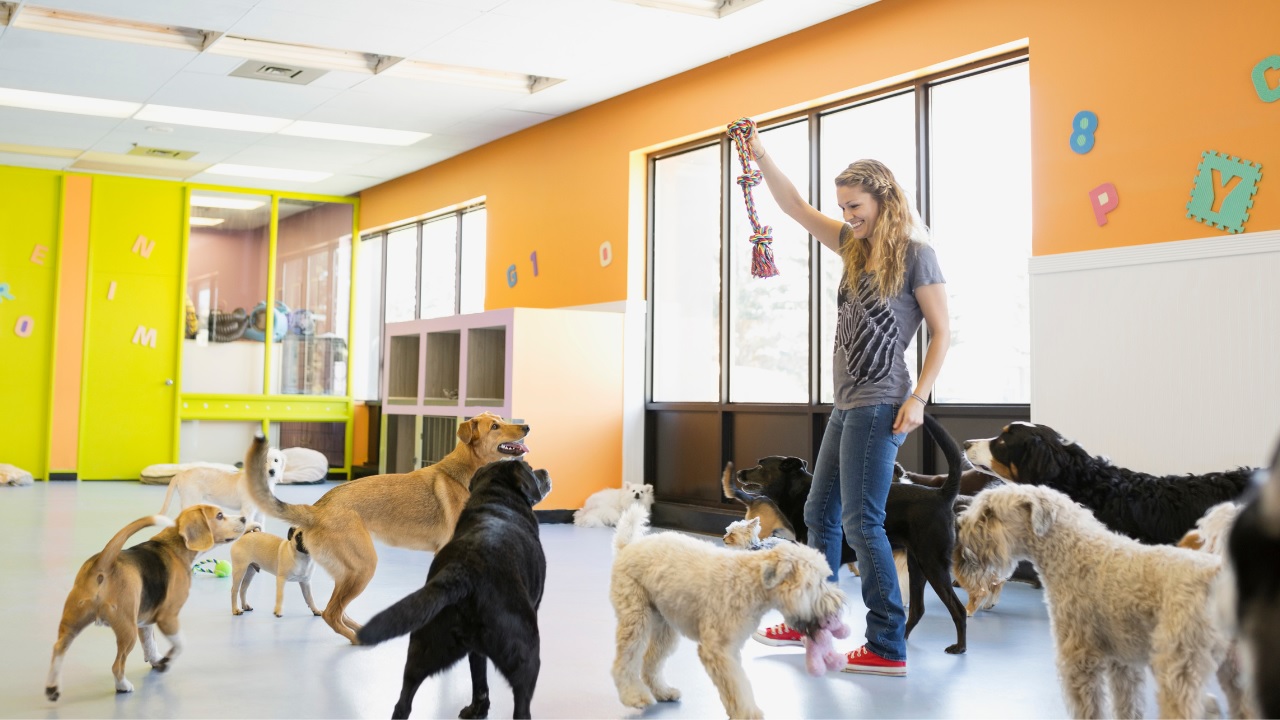
If you’re serious about raising the standard of care—whether as an owner, investor, or operator—you have to ask a better question. Not “Is the dog supervised?” but “Is the environment engineered?” Because a retreat is not about containment. It is about design precision. It is about understanding that a dog’s nervous system, joints, senses, and social instincts require intentional architecture.
A well-curated dog retreat is built, quite literally, around biological joy and recovery.
1. Multi-Sensory Micro-Climates: Engineering Environmental Choice
A true retreat eliminates monotony. It replaces static rooms with purpose-built micro-climates that replicate environmental diversity city life suppresses.
- Sand zones (“Beach Club”) for unstable surface training that improves proprioception and paw strength.
- Meadow runs with natural grass to support full-stride galloping.
- Woodchip paths for tactile exploration and scent layering.
- Shallow paddling pools for thermal regulation and low-impact movement.
The strategic advantage of such a doggy day care facility is choice; dogs self-select intensity and regulate their own experience with professional guidance. That means: Instead of waiting for a dog to bark or snap, a professional recognizes “micro-expressions”—a stiffened tail or a hard stare—and uses a calm verbal cue or body-blocking to redirect the dog to a different zone.
This is environmental psychology, not decoration. And when you see this through live-stream visibility, you’re not guessing about enrichment—you’re witnessing terrain engagement in real time.
2. The Parasympathetic Anchor: Designing for Deep Recovery
Most facilities overvalue stimulation. Retreat-grade care understands that recovery is the real luxury. Purpose-built heated pup lounges and insulated cabins function as neurological anchors. They are physically and acoustically separated from high-energy zones. No reverberating bark chambers. No chaotic overlap. Just controlled quiet and thermal comfort.
This matters because:
- Transitioning from play to rest activates the parasympathetic nervous system.
- Warmth supports muscular recovery.
- Acoustic control prevents cortisol re-spiking during downtime.
When owners observe their dog moving from alert exploration into genuine, stretched-out sleep, they’re seeing something rare: decompression. That shift—from hyper-vigilant “city guard” to fully relaxed companion—is the measurable signature of a real retreat.
3. Curated Social Safe-Havens: Precision Pack Dynamics
Socialization is often misunderstood as volume. More dogs. More play. More chaos. However, retreat-level facilities focus on practical alignment and biological balance. They curate social harmony with consistent pack circles—zoned by size, temperament, and energy profile.
- Small and medium dogs are shielded from size intimidation.
- High-energy groups are separated from low-threshold temperaments.
- Familiar peers rotate together, allowing stable social hierarchies to form.
Such a strategy helps move away from the idea of a playground and toward the idea of a behavioral architecture.
The outcome? Confidence builds organically. Dogs stop scanning for threat and start engaging with ease. That ease—visible in relaxed tails, soft posture, and playful reciprocity—is what owners recognize in digital updates as “joy.” But behind that joy is professional behavioral calibration.
4. The Rinse and Restore Ritual: Managing the Transition Home
A retreat is incomplete if the return to the city is abrupt. The transition must be engineered as carefully as the day itself.
Strategies that enhance the shift from high-performance play to home-ready serenity include:
- Spa-style washes that signal sensory cues the adventure is concluding.
- Calm handling to lower arousal before departure.
- Climate-controlled transport that protects the dog’s regulated state.
This isn’t cosmetic. It’s neurological continuity.
When the dog arrives home clean, settled, and physiologically balanced—without the stress spike of chaotic loading or cold transport—the retreat experience remains intact. Even integrated supply delivery reduces friction for the owner, reinforcing that this is a full-service system, not a patchwork solution.
In essence, a high-performance dog care must leverage the biological pulse—the rhythm of activity and recovery. A retreat like facility helps your dog move from a “good” experience to a “transformative” one. However, as a dog owner you want a dog day care that strategizes on regulated resilience—an animal that can enjoy the intensity of a countryside pack and then transition seamlessly back to a high-end urban flat without behavioral fallout. A reputable dog day care facility is not just a “factor”—it is the foundation of the entire strategy.
